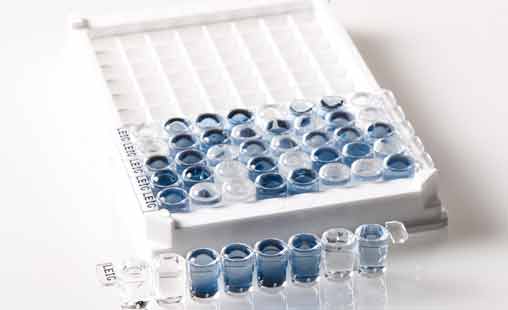
VetLine Borrelia (Lyme), Elisa kit
- Placa de microtitulación: 12 tiras desmontables de 8 pocillos recubiertas con antígenos de Borrelia; en bolsa de aluminio resellable
- Tampón de dilución de muestra: 1 frasco con 100 mL de tampón fosfato (10 mM) para la dilución de muestras; pH 7,2 ± 0,2; color amarillo; listo para usar; tapa blanca; ≤ 0,0015 % (v/v) CMIT/MIT (3:1)
- Solución de parada: 1 frasco con 15 mL de ácido sulfúrico 0,2 mol/L; listo para usar; tapa roja
- Tampón de lavado (20× conc.): 1 frasco con 50 mL de tampón fosfato (0,2 M) concentrado 20 veces; pH 7,2 ± 0,2; para el lavado de los pocillos; tapa blanca
- Conjugado: 1 frasco con 20 mL de proteína A/G marcada con peroxidasa; color amarillo; listo para usar; tapa blanca; ≤ 0,02 % (v/v) MIT
- Solución de sustrato TMB: 1 frasco con 15 mL de 3,3’,5,5’-tetrametilbenzidina (TMB), < 0,1 %; listo para usar; tapa amarilla
- Control positivo: 1 vial con 2 mL; color amarillo; listo para usar; tapa roja; ≤ 0,02 % (v/v) MIT
- Control de punto de corte (cut-off): 1 vial con 3 mL; color amarillo; listo para usar; tapa verde; ≤ 0,02 % (v/v) MIT
- Control negativo: 1 vial con 2 mL; color amarillo; listo para usar; tapa azul; ≤ 0,0015 % (v/v) CMIT/MIT (3:1)
1. INTRODUCTION
Lyme disease (Borreliosis) is a tick-borne, bacterial disease of domestic animals and humans. It is caused by spirochetes of the Borrelia burgdorferi sensu lato group. In Europe, the most frequently isolated pathogenic genospecies of humans and dogs are Borrelia afzelii, Borrelia garinii and Borrelia burgdorferi sensu stricto.
Borrelia are helically wound, flexible, highly motile bacteria. By rotation of their axial filaments (periplasmatic flagella) they are able to move efficiently in corkscrew fashion through viscous media (serum). Thereby they can disseminate throughout the body within days to weeks of infection.
The pathogens are transmitted by various tick species of the genus Ixodes. In Europe, Ixodes ricinus is the most important vector. However, infestation rates with Borrelia vary depending on the region. In endemic areas of Germany, approximately 3-7 % of the larvae and 10-34 % of nymphs and adult ticks are infected by Borrelia burgdorferi sensu lato. Natural reservoirs are wild animals, including rodents as well as many other small mammals and birds. The ticks take their meals (blood) from these hosts.
Since dogs frequent the areas ticks live, they are more affected than humans. Typical tick habitats are the edge of the woods, bushes, undergrowth and tall grass; but infected ticks can also be found in public parks.
Symptoms of Lyme disease in dog comprise fever, apathy, loss of appetite and anorexia as well as recurrent and shifting lameness and polyarthritis. The characteristic rash or the circular area of redness around the bite (erythema chronicum migrans) which is seen in man may be absent or is overlooked due to hair coat or dark pigmentation.
2. INTENDED USE
The NovaTec VetLine Borrelia ELISA is intended for the qualitative determination of antibodies against Borrelia in veterinary serum.
3. PRINCIPLE OF THE ASSAY
The qualitative immunoenzymatic determination of specific antibodies is based on the ELISA (Enzyme-linked Immunosorbent Assay) technique.
Microtiterplates are coated with specific antigens to bind corresponding antibodies of the sample. After washing the wells to remove all unbound sample material a horseradish peroxidase (HRP) labelled conjugate is added. This conjugate binds to the captured antibodies. In a second washing step unbound conjugate is removed. The immune complex formed by the bound conjugate is visualized by adding Tetramethylbenzidine (TMB) substrate which gives a blue reaction product.
The intensity of this product is proportional to the amount of specific antibodies in the sample. Sulphuric acid is added to stop the reaction. This produces a yellow endpoint colour. Absorbance at 450/620 nm is read using an ELISA Microtiterplate reader.
4. MATERIALS
4.1. Reagents supplied
- Microtiterplate: 12 break-apart 8-well snap-off strips coated with Borrelia antigens; in resealable aluminium foil.
- Sample Dilution Buffer: 1 bottle containing 100 mL of phosphate buffer (10 mM) for sample dilution; pH 7.2 ± 0.2; coloured yellow; ready to use; white cap; ≤ 0.0015 % (v/v) CMIT/MIT (3:1).
- Stop Solution: 1 bottle containing 15 mL sulphuric acid, 0.2 mol/L; ready to use; red cap.
- Washing Buffer (20x conc.): 1 bottle containing 50 mL of a 20-fold concentrated phosphate buffer (0.2 M), pH 7.2 ± 0.2, for washing the wells; white cap.
- Conjugate: 1 bottle containing 20 mL of peroxidase labelled Protein A/G; coloured yellow; ready to use; white cap; ≤ 0.02 % (v/v) MIT.
- TMB Substrate Solution: 1 bottle containing 15 mL 3,3',5,5'-tetramethylbenzidine (TMB), < 0.1 %; ready to use; yellow cap.
- Positive Control: 1 vial containing 2 mL; coloured yellow; ready to use; red cap; ≤ 0.02 % (v/v) MIT.
- Cut-off Control: 1 vial containing 3 mL; coloured yellow; ready to use; green cap; ≤ 0.02 % (v/v) MIT.
- Negative Control: 1 vial containing 2 mL; coloured yellow; ready to use; blue cap; ≤ 0.0015 % (v/v) CMIT/MIT (3:1).
For hazard and precautionary statements see 12.1
For potential hazardous substances please check the safety data sheet.
4.2. Materials supplied
- 1 Cover foil
- 1 Instruction for use (IFU)
- 1 Plate layout
4.3. Materials and Equipment needed
- ELISA Microtiterplate reader, equipped for the measurement of absorbance at 450/620 nm
- Incubator 37 °C
- Manual or automatic equipment for rinsing Microtiterplate wells
- Pipettes to deliver volumes between 10 and 1000 µL
- Vortex tube mixer
- Distilled water
- Disposable tubes
5. STABILITY AND STORAGE
Store the kit at 2...8 °C. The opened reagents are stable up to the expiry date stated on the label when stored at 2...8 °C.
6. REAGENT PREPARATION
It is very important to bring all reagents and samples to room temperature (20…25 °C) and mix them before starting the test run!
6.1. Microtiterplate
The break-apart snap-off strips are coated with Borrelia antigens. Immediately after removal of the strips, the remaining strips should be resealed in the aluminium foil along with the desiccant supplied and stored at 2...8 °C.
6.2. Washing Buffer (20x conc.)
Dilute Washing Buffer 1 + 19; e. g. 10 mL Washing Buffer + 190 mL distilled water. The diluted buffer is stable for 5 days at room temperature (20…25 °C). In case crystals appear in the concentrate, warm up the solution to 37 °C e.g. in a water bath. Mix well before dilution.
6.3. TMB Substrate Solution
The reagent is ready to use and has to be stored at 2...8 °C, away from the light. The solution should be colourless or could have a slight blue tinge. If the substrate turns into blue, it may have become contaminated and should be thrown away.
7. SAMPLE COLLECTION AND PREPARATION
Use canine serum samples with this assay. If the assay is performed within 5 days after sample collection, the samples should be kept at 2...8 °C; otherwise they should be aliquoted and stored deep-frozen (-70…-20 °C). If samples are stored frozen, mix thawed samples well before testing. Avoid repeated freezing and thawing. Heat inactivation of samples is not recommended.
7.1. Sample Dilution
Before assaying, all samples should be diluted 1+100 with Sample Dilution Buffer. Dispense 10 µL sample and 1 mL Sample Dilution Buffer into tubes to obtain a 1+100 dilution and thoroughly mix with a Vortex.
8. ASSAY PROCEDURE
Please read the instruction for use carefully before performing the assay. Result reliability depends on strict adherence to the instruction for use as described. The following test procedure is only validated for manual procedure. If performing the test on ELISA automatic systems we recommend increasing the washing steps from three up to five and the volume of Washing Buffer from 300 µL to 350 µL to avoid washing effects. Pay attention to chapter 12. Prior to commencing the assay, the distribution and identification plan for all samples and standards/controls (duplicates recommended) should be carefully established on the plate layout supplied in the kit. Select the required number of microtiter strips or wells and insert them into the holder.
Perform all assay steps in the order given and without any delays.
A clean, disposable tip should be used for dispensing each standard/control and sample.
Adjust the incubator to 37 ± 1 °C.
- 1. Dispense 100 µL standards/controls and diluted samples into their respective wells. Leave well A1 for the Substrate Blank.
- 2. Cover wells with the foil supplied in the kit.
- 3. Incubate for 1 hour ± 5 min at 37 ± 1 °C.
- 4. When incubation has been completed, remove the foil, aspirate the content of the wells and wash each well three times with 300 µL of Washing Buffer. Avoid overflows from the reaction wells. The interval between washing and aspiration should be > 5 sec. At the end carefully remove remaining fluid by tapping strips on tissue paper prior to the next step! Note: Washing is important! Insufficient washing results in poor precision and false results.
- 5. Dispense 100 µL Conjugate into all wells except for the Substrate Blank well A1.
- 6. Incubate for 30 min at room temperature (20...25 °C). Do not expose to direct sunlight.
- 7. Repeat step 4.
- 8. Dispense 100 µL TMB Substrate Solution into all wells.
- 9. Incubate for exactly 15 min at room temperature (20...25 °C) in the dark. A blue colour occurs due to an enzymatic reaction.
- 10. Dispense 100 µL Stop Solution into all wells in the same order and at the same rate as for the TMB Substrate Solution, thereby a colour change from blue to yellow occurs.
- 11. Measure the absorbance at 450/620 nm within 30 min after addition of the Stop Solution.
8.1. Measurement
Adjust the ELISA Microtiterplate reader to zero using the Substrate Blank.
If - due to technical reasons - the ELISA Microtiterplate reader cannot be adjusted to zero using the Substrate Blank, subtract its absorbance value from all other absorbance values measured in order to obtain reliable results!
Measure the absorbance of all wells at 450 nm and record the absorbance values for each standard/control and sample in the plate layout.
Bichromatic measurement using a reference wavelength of 620 nm is recommended.
Where applicable calculate the mean absorbance values of all duplicates.
9. RESULTS
9.1. Run Validation Criteria
In order for an assay to be considered valid, the following criteria must be met:
- Substrate Blank: Absorbance value < 0.100
- Negative Control: Absorbance value < 0.200 and < Cut-off
- Cut-off Control: Absorbance value 0.150 – 1.300
- Positive Control: Absorbance value > Cut-off
If these criteria are not met, the test is not valid and must be repeated.
9.2. Calculation of Results
The Cut-off is the mean absorbance value of the Cut-off Control determinations.
Example: Absorbance value Cut-off Control 0.44 + absorbance value Cut-off control 0.42 = 0.86 / 2 = 0.43
Cut-off = 0.43
9.2.1. Results in Units [NTU]
= [NovaTec-units = NTU]
Ejemplo: = 0,37 NTU
9.3. Interpretation of Results
Normal value ranges for this ELISA should be established by each laboratory based on its own sample populations in the geographical areas serviced.
The following values should be considered as a guideline:
| Cut-off | 10 NTU | - |
|---|---|---|
| Positive | > 11 NTU |
Antibodies against the pathogen are present.
There has been a contact with the antigen (pathogen resp. vaccine). |
| Equivocal | 9 – 11 NTU |
Antibodies against the pathogen could not be detected clearly.
It is recommended to repeat the test with a fresh sample in 2 to 4 weeks. If the result is equivocal again the sample is judged as negative. |
| Negative | < 9 NTU |
The sample contains no antibodies against the pathogen.
A previous contact with the antigen (pathogen resp. vaccine) is unlikely. |
| Diagnosis of an infectious disease should not be established on the basis of a single test result. A precise diagnosis should take into consideration clinical history, symptomatology as well as serological data. | ||
10. SPECIFIC PERFORMANCE CHARACTERISTICS
The results refer to the groups of samples investigated; these are not guaranteed specifications.
The performance data have been established with canine samples. Due to the nature of the Protein A/G conjugate this ELISA should react with other mammalian species also. More detailed information is available on request.
10.1. Precision
| Intraassay | n | Mean (E) | CV (%) |
|---|---|---|---|
| #1 | 24 | 0.517 | 4.00 |
| #2 | 24 | 1.790 | 4.23 |
| #3 | 24 | 2.339 | 9.94 |
| Intraassay | n | Mean (NTU) | CV (%) | #1 | 12 | 37.2 | 4.17 |
|---|---|---|---|
| #2 | 12 | 45.3 | 9.28 |
| #3 | 12 | 1.90 | 9.94 |
10.2. Diagnostic Specificity
The diagnostic specificity is defined as the probability of the assay of scoring negative in the absence of the specific analyte.
Diagnostic Specificity canine: 92.86 % (95 % confidence interval: 66.13 % - 99.82 %)
10.3. Diagnostic Sensitivity
The diagnostic sensitivity is defined as the probability of the assay of scoring positive in the presence of the specific analyte.
Diagnostic Sensitivity canine: 95.00 % (95 % confidence interval: 75.13 % - 99.87 %)
10.4. Interferences
Interferences with hemolytic, lipemic or icteric samples are not observed up to a concentration of 10 mg/mL hemoglobin, 5 mg/mL triglycerides and 0.5 mg/mL bilirubin.
10.5. Cross Reactivity
Cross reactions, especially against spirochetes, cannot be excluded.
11. LIMITATIONS OF THE PROCEDURE
Bacterial contamination or repeated freeze-thaw cycles of the sample may affect the absorbance values.
12.PRECAUTIONS AND WARNINGS
- Only for veterinary in-vitro diagnostic use.
- All materials of human or animal origin should be regarded and handled as potentially infectious.
- All components of human origin used for the production of these reagents have been tested for anti-HIV antibodies, anti-HCV antibodies and HBsAg and have been found to be non-reactive.
- Do not interchange reagents or strips of different production lots.
- No reagents of other manufacturers should be used along with reagents of this test kit.
- Do not use reagents after expiry date stated on the label.
- Use only clean pipette tips, dispensers, and lab ware.
- Do not interchange screw caps of reagent vials to avoid cross-contamination.
- Close reagent vials tightly immediately after use to avoid evaporation and microbial contamination.
- After first opening and subsequent storage check conjugate and standard/control vials for microbial contamination prior to further use.
- To avoid cross-contamination and falsely elevated results pipette patient samples and dispense reagents without splashing accurately into the wells.
- The ELISA is only designed for qualified personnel who are familiar with good laboratory practice.
12.1. Safety note for reagents containing hazardous substances
Reagents may contain CMIT/MIT (3:1) or MIT (refer to 4.1)
Therefore, the following hazard and precautionary statements apply.
| Warning | H317 | May cause an allergic skin reaction. |
| P261 | Avoid breathing spray. | |
| P280 | Wear protective gloves/protective clothing. | |
| P302+P352 | IF ON SKIN: Wash with plenty of soap and water. | |
| P333+P313 | If skin irritation or rash occurs: Get medical advice/attention. | |
| P362+P364 | Take off contaminated clothing and wash it before reuse. |
Further information can be found in the safety data sheet.
12.2. Disposal Considerations
Residues of chemicals and preparations are generally considered as hazardous waste. The disposal of this kind of waste is regulated through national and regional laws and regulations. Contact your local authorities or waste management companies which will give advice on how to dispose hazardous waste.
13. ORDERING INFORMATION
Prod. No.: BORVT0040 VetLine Borrelia ELISA (96 Determinations)
ABBREVIATIONS / ABKÜRZUNGEN / ABRÉVIATIONS / ABBREVIAZIONI / ABREVIACIÓNES /ABREVIATURAS
| CMIT | 5-chloro-2-methyl-4-isothiazolin-3-one |
| MIT | 2-methyl-2H-isothiazol-3-one |
SUMMARY OF TEST PROCEDURE / KURZANLEITUNG TESTDURCHFÜHRUNG / RÉSUMÉ DE LA PROCEDURE DE TEST / SCHEMA DELLA PROCEDURA / RESUMEN DE LA TÉCNICA / RESUMO DO PROCEDIMENTO DE TESTE
SCHEME OF THE ASSAY
VetLine Borrelia ELISA
Test Preparation
Prepare reagents and samples as described.
Establish the distribution and identification plan for all samples and standards/controls on the plate
layout supplied in the kit.
Select the required number of microtiter strips or wells and insert them into the holder.
Assay Procedure
| Pipetting Scheme | Substrate Blank (A1) |
Negative Control | Cut-off Control | Positive Control | Sample (diluted 1+100) |
|---|---|---|---|---|---|
| Negative Control | - | 100 µL | - | - | - |
| Cut-off Control | - | - | 100 µL | - | - |
| Positive Control | - | - | - | 100 µL | - |
| Sample (diluted 1+100) |
- | - | - | - | 100 µL |
|
Cover wells with foil supplied in the kit. Incubate for 1 h at 37±1 °C. Wash each well three times with 300 µL of Washing Buffer. |
|||||
| Conjugate | - | 100 µL | 100 µL | 100 µL | 100 µL |
|
Incubate for 30 min at room temperature (20 - 25 °C). Do not expose to direct sunlight. Wash each well three times with 300 µL of Washing Buffer. |
|||||
| TMB Substrate Solution | 100 µL | 100 µL | 100 µL | 100 µL | 100 µL |
| Incubate for exactly 15 min at room temperature (20...25 °C) in the dark. | |||||
| Stop Solution | 100 µL | 100 µL | 100 µL | 100 µL | 100 µL |
| 📊 Photometric measurement at 450 nm (reference wavelength: 620 nm) | |||||
BORVT0040 engl,dt,es 11052020-TL